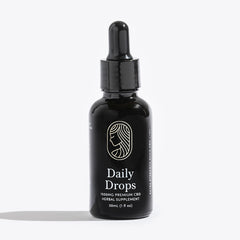

Most people who take Daily Stress Gummies notice it sideways: a couple weeks in, the overwhelm that used to feel like a traffic jam in their chest loosens up. Sleep starts feeling more like rest. The small frustrations don't have the same grip. They're not calmer because nothing is happening — they're calmer through things happening.
That's what this formula was built for.
Ashwagandha, L-theanine, lemon balm, and passionflower each work at a different point in the body's stress response — from the hormonal system that fires the first alarm signal, all the way down to the receptor sites where the nervous system registers ease. They're not interchangeable, and they're not redundant. Think of it like a relay: each ingredient picks up where the last one can't reach alone.
Here's what each one does, and why they work better together.
Key Takeaways
- The Daily Stress Gummies formula targets the stress response at four distinct points: HPA axis activity, alpha brain wave state, GABA availability, and GABA receptor activation
- Ashwagandha is the upstream ingredient — used as a high-quality standardized extract, it works on the hormonal stress system, with effects that build over 4–8 weeks of consistent daily use
- L-theanine bridges both pathways: it produces calm alertness within 30–60 minutes while also supporting GABA and serotonin levels over time
- Lemon balm and passionflower both work through the GABA system, but at different entry points — lemon balm preserves GABA availability; passionflower activates the receptor GABA binds to
- This formula is designed for daily cumulative use, not acute or as-needed relief*
Starting Upstream: Ashwagandha and the HPA Axis
The stress response doesn't start in your nervous system — it starts higher up, in a hormonal cascade called the HPA axis (hypothalamic-pituitary-adrenal). When the brain perceives a stressor, the hypothalamus signals the pituitary gland, which signals the adrenal glands to release cortisol. That cortisol then ripples through the body — influencing energy, immune function, sleep quality, and mood.
Ashwagandha (Withania somnifera), used in Daily Stress Gummies as a clinically verified standardized extract, works at this upstream level. In randomized controlled trials, ashwagandha supplementation has been associated with statistically significant reductions in serum cortisol and self-reported stress after 8 weeks of consistent daily use. A 2025 meta-analysis across 12 clinical trials confirmed meaningful reductions in both subjective stress scores and morning cortisol levels.*
Ashwagandha doesn't work on the moment — it works on the system. Over weeks of consistent use, it may support how the HPA axis calibrates to repeated demands, rather than blunting a single stress response.
This is a cumulative ingredient. People who take it occasionally or inconsistently are unlikely to see the same results as those who build it into a daily protocol for at least 6–8 weeks. That distinction matters for expectation-setting.
⚠️ Thyroid note: Ashwagandha has shown thyroid-stimulating effects in some studies. If you have a diagnosed thyroid condition or take thyroid medication, consult your healthcare provider before adding ashwagandha to your routine.
For a broader look at how adaptogens work as a class, see What Are Adaptogens?.
The Bridge: L-Theanine's Dual Role
L-theanine is an amino acid found naturally in green tea. It's also the ingredient in this formula that spans both the hormonal and the nervous system sides of the stress response — which is what makes it structurally essential, not supplementary.
Its mechanism operates on two timescales:
Fast (30–60 minutes): L-theanine crosses the blood-brain barrier and increases alpha brain wave activity — the brain state associated with calm, focused awareness. Research by Nobre et al. demonstrated measurable increases in alpha oscillations within 45 minutes of a single dose. Crucially, this is not sedation. Alpha wave activity produces alert calm, not drowsiness — which is why L-theanine works in a daytime formula without making you foggy.*
Sustained (consistent use): L-theanine also supports elevated brain GABA and serotonin levels, contributing to the same calming system that lemon balm and passionflower address through different mechanisms. This longer-range effect complements the other botanicals rather than duplicating them.*
L-theanine is the bridge: faster-acting than ashwagandha, with a different mechanistic pathway than the GABA botanicals, and connecting both sides of the formula across time.
Protecting the Calm: Lemon Balm and the GABA Supply
GABA (gamma-aminobutyric acid) is the brain's primary inhibitory neurotransmitter — the signal that quiets neural activity and allows the nervous system to downregulate. When GABA is abundant, the brain transitions more readily from activation to rest. When it's depleted, that transition becomes harder.
Lemon balm (Melissa officinalis) works on GABA, but not by generating more of it. Instead, its active compound, rosmarinic acid, inhibits GABA-transaminase (GABA-T) — the enzyme that breaks GABA down in the synapse. By slowing that breakdown, more GABA remains available to do its job.*
Lemon balm doesn't create GABA. It protects what's already there — slowing the drain rather than opening the tap.
Human trials associate lemon balm with improvements in sleep quality and self-reported emotional stress, though most studies to date are small and short-duration, so benefits should be framed accordingly. The underlying mechanism is well-characterized; larger clinical data is still emerging. At typical doses, lemon balm is non-sedating and well-suited to daily use.*
Activating the Signal: Passionflower at the Receptor
Where lemon balm works on GABA availability, passionflower (Passiflora incarnata) works one step further downstream — at the receptor itself.
Preclinical evidence shows that passionflower extracts interact with GABA-A and GABA-B receptors, the same receptor subtypes targeted by benzodiazepine medications — though through a gentler, partial-agonist mechanism rather than full receptor activation. This means passionflower may support the receptor's ability to respond to GABA without the sedation profile or dependency risk of pharmaceutical GABA-acting agents.*
This is the key non-redundancy with lemon balm: they target different entry points in the same system. Lemon balm preserves the supply of GABA circulating in the synapse. Passionflower activates the receptor that GABA binds to when it arrives. One protects the signal; the other ensures the signal lands.
Human randomized controlled trials associate passionflower supplementation with improved sleep quality and stress resilience measures, though the mechanistic receptor evidence remains primarily preclinical. Clinical claims should be framed as "emerging" rather than established.*
⚠️ Interaction note: Passionflower may enhance the effects of sedative medications. If you take prescription sleep aids, benzodiazepines, or other CNS depressants, consult your healthcare provider before use.
Why These Four Together? The Formula Logic
The stress response isn't a single switch — it's a cascade that moves from upstream hormonal signaling through the nervous system to neurotransmitter activity at the synapse level. A formula that targets only one point in that cascade leaves the others unaddressed.
The four ingredients in Daily Stress Gummies map directly onto that cascade:
- Ashwagandha → HPA axis (hormonal, upstream, cumulative over weeks)
- L-theanine → Alpha brain wave activity + GABA/serotonin support (fast + sustained, bridge role)
- Lemon balm → GABA availability (enzyme-level preservation, daily maintenance)
- Passionflower → GABA receptor activation (receptor-level, non-redundant with lemon balm)
The result isn't overlap — it's coverage. Each ingredient is doing something the others aren't.
A systematic review of GABA-modulating plant medicines by Savage et al. (2018) identified these botanical categories as representing genuinely distinct mechanisms within the stress and calming system — a finding that supports the logic of multi-ingredient, multi-mechanism formulation over single-ingredient approaches. Multi-botanical combination formulas targeting both HPA and GABA pathways have also shown meaningful effects on stress and mood outcomes in clinical trials, consistent with this stacking rationale.*
The formula is built for daily use over time. Think of it less like a supplement you take when you need it, and more like a protocol that reshapes how your system handles what summer — and everything else — throws at it.
How to Use the Daily Stress Gummies
For daily cumulative stress support:
Daily Stress Gummies →
Take daily, consistently. Allow 4–8 weeks to assess the full effect of the ashwagandha component. L-theanine's calm alertness effect is typically noticeable within the first week.*
For standalone HPA axis support:
Stress Less Ashwagandha →
The same standardized ashwagandha extract in standalone capsule form — for those who want to isolate the HPA pathway, or who prefer capsule format.*
For personalized guidance:
1:1 Coaching →
An Equilibria Dosage Specialist can help you build a stacking protocol that integrates the Stress Gummies with CBD, sleep support, or hormone-related wellness goals — especially useful if you're navigating a thyroid condition or medication interactions.*
Frequently Asked Questions
What are the ingredients in Equilibria's Daily Stress Gummies?
Equilibria's Daily Stress Gummies contain four active botanical ingredients: a clinically standardized ashwagandha extract, L-theanine, lemon balm extract, and passionflower extract. Each ingredient targets a different part of the body's stress response system — from the HPA axis (the hormonal command center) to the GABA system (the brain's primary calming pathway). The formula is designed for consistent daily use, not acute or as-needed relief.*
How long does it take for the Daily Stress Gummies to work?
It depends on the ingredient. L-theanine produces measurable calm alertness — via alpha brain wave activity — within 30–60 minutes of ingestion. Ashwagandha works cumulatively: clinical trials show statistically significant cortisol reductions after 8 weeks of consistent daily use. Most people notice a meaningful shift in baseline stress levels around weeks 4–6, with more pronounced effects emerging around weeks 8–12. This formula is not designed for immediate relief — it's designed to shift how your nervous system responds to ongoing demands over time.*
Can I take the Daily Stress Gummies with CBD?
Yes. The Stress Gummies and Equilibria's CBD products target different systems and are frequently used together. The Stress Gummies work primarily on the HPA axis and GABA system; CBD works through the endocannabinoid system (ECS). For guidance on how to integrate both into a daily routine, see How to Build a CBD Wellness Routine or connect with a Dosage Specialist.*
Is ashwagandha safe if I have a thyroid condition?
Ashwagandha has shown thyroid-stimulating effects in some studies and should be used with caution if you have a diagnosed thyroid condition (hypo- or hyperthyroid) or take thyroid medication. Consult your healthcare provider before adding ashwagandha-containing supplements to your routine.*
*These statements have not been evaluated by the Food and Drug Administration. This product is not intended to diagnose, treat, cure, or prevent any disease.