
The format you choose matters more than most people expect — not because one is superior, but because how CBD enters your body shapes when it works and how precisely you can use it.
Key Takeaways
- Drops act faster because they absorb sublingually: held under the tongue, CBD enters the bloodstream directly through blood vessels rather than the digestive tract, with onset typically around 15–30 minutes.
- Gummies take longer but deliver steady, sustained effects: digestion-dependent absorption means effects set in around 45–60 minutes and tend to last longer — well suited for consistent daily support.
- Drops let you adjust your dose in real time: because you measure in drops or fractions of a dropper, you can fine-tune up or down without opening a new package.
- Gummies are low-friction and travel-friendly: a fixed-dose format works well when simplicity and routine matter more than precision.
- Using both together is a legitimate strategy: many Equilibria members use gummies for their daily baseline and reach for drops during windows of acute stress — this is exactly what stacking is designed for.
How Does CBD Get Into Your Body Differently From Drops vs. Gummies?
This comes down to the absorption pathway — where and how CBD crosses from the product into your bloodstream.
With sublingual drops, you hold the oil under your tongue for 60–90 seconds. The tissue there is rich in capillaries, and CBD passes directly into the blood without first traveling through the digestive system. This bypasses what's called first-pass metabolism — the liver processing that breaks down a significant portion of an orally ingested compound before it reaches circulation. The result is faster onset and, in general, higher relative bioavailability.
With gummies, CBD is digested like food. It moves through the stomach and small intestine, gets processed by the liver, and then enters general circulation. This process takes time — most people notice effects somewhere between 45 and 60 minutes after taking a gummy, sometimes longer. The upside: the effects tend to feel more gradual and sustained, which is actually what you want for a consistent daily foundation.
Neither pathway is wrong. They're designed for different things.
This timing logic applies across Equilibria's gummy formats — CBD, CBN, and low-dose THC gummies all follow the same digestive absorption pathway. THC-containing gummies in particular tend to have a longer and less predictable onset window, often 60–120 minutes or more, due to additional metabolic factors involved in processing THC through the digestive tract. If you're using a THC gummy and timing the experience matters, build in extra buffer.
Which Format Gives You More Control Over Your Dose?
A note on dosage context: the comparisons in this article reference our regular-strength 10mg CBD formats. The format principles hold across strengths, but if you're working with Extra Strength or a different milligram per serving, your specific dose amounts and timing will differ accordingly.
If dosing precision matters to you — and for many women navigating hormonal shifts, stress cycles, or sleep patterns that change week to week, it does — drops have a meaningful advantage.
A standard dropper holds 1 mL, which you can take as a full serving or split into halves or quarters. That means you can make small, deliberate adjustments without committing to a whole new dose increment. This matters especially during the early weeks of finding your baseline, or any time your needs shift temporarily (travel, high-stress seasons, cycle-related changes).
Gummies are fixed. One gummy is one dose — you can split them, but it's imprecise. For many people, that's not a problem at all: once you've found a dose that works, a fixed format is easier to be consistent with. Consistency, more than any single dose, is what drives long-term results with CBD.
The short version: drops for dialing in; gummies for maintaining.
Which Is Better for Sleep vs. Stress Relief?
This is one of the most common questions we hear, and the honest answer is: it depends less on the format and more on the timing of your need.
For acute stress — the kind that hits during a presentation, a difficult conversation, or the moment you realize you forgot something important — drops are the more practical choice. Faster onset means the support arrives within a window that's actually relevant to what's happening. If you're reaching for something in the middle of a stressful afternoon, a gummy taken at that moment won't be felt for nearly an hour.
For sleep, gummies often work well precisely because of their slower, more sustained release curve. Taking a gummy 45–60 minutes before bed aligns the absorption window with when you want to feel settled. That said, drops taken 20–30 minutes before bed can also be effective — especially for people who want to fine-tune their dose night by night.
Both formats may support relaxation and sleep through interactions with the endocannabinoid system — the body's regulatory network involved in stress response, sleep-wake cycles, and mood. Drops or gummies are simply different delivery vehicles for the same compound reaching the same system.
Can You Use CBD Drops and Gummies Together?
Yes — and it's a strategy many experienced CBD users find genuinely useful.
The approach, sometimes called CBD stacking, involves using gummies as a daily baseline (consistent timing, consistent dose) and drops as an on-demand layer for moments that call for faster support. The two formats don't compete; their absorption curves are different enough that they serve complementary roles.
If you're new to CBD, we'd suggest starting with one format and establishing your baseline first — usually two to four weeks — before adding the other. Trying to fine-tune two variables at once makes it harder to understand what's working.
For most people, the gummy-as-baseline, drops-as-responsive approach ends up being the most useful combination once you're past the initial calibration phase.
Which CBD Format Is Right for You?
A few questions worth asking yourself:
Choose drops if: you want flexibility, you're still dialing in your dose, you tend to need support at unpredictable moments, or you're interested in stacking CBD with other botanicals in your routine.
Choose gummies if: you want a simple, no-friction daily habit, your needs are fairly consistent, or you prefer not to think about dosing once you've found what works.
Choose both if: you've established a baseline and want the option to respond in real time to stress or sleep challenges — without having to carry extra products everywhere you go.
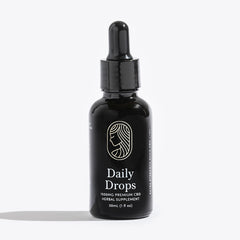
Our Daily Drops and Daily Drops Extra Strength are formulated for sublingual use in a full-spectrum hemp oil base. Our Daily Gummies are a fixed-dose, broad-spectrum option that integrates easily into any routine.
One thing worth naming: format is one piece of the picture. Dose and timing are the other two — and where those three variables intersect is where your routine gets personal. If you're navigating that and want support, our Certified Wellness Coaches work with members one-on-one to build routines that actually fit.
The format question is worth getting right — because the best CBD product is the one that fits how you actually live.
Frequently Asked Questions
How long do CBD drops take to work compared to gummies?
CBD drops taken sublingually typically produce noticeable effects within 15–30 minutes, since absorption happens through blood vessels under the tongue rather than through digestion. CBD gummies generally take 45–60 minutes to take effect, sometimes longer depending on factors like whether you've eaten recently and individual metabolism. If you need support within a specific time window, drops are more reliable for timing.
Can I adjust my CBD dose more easily with drops or gummies?
Drops offer significantly more flexibility. Because you measure by the dropper, you can take a half or quarter serving without any guesswork — useful during the early phase of finding your baseline, or when your needs change temporarily. Gummies are a fixed dose per piece; while you can cut them, precision is harder to achieve. Once you've found a dose that works for you, a fixed-dose gummy format can actually be easier to stay consistent with.
Are CBD drops or gummies better for sleep?
Both formats may support sleep, but the timing works differently. Gummies, taken 45–60 minutes before bed, align well with their slower absorption curve and tend to produce a gradual, sustained feeling of calm. Drops taken 20–30 minutes before bed can be effective for people who want to fine-tune their dose night to night or fall asleep faster. Some people use drops for an immediate pre-bed wind-down and gummies as part of a consistent nightly routine — both approaches are valid.
Can I take CBD drops and gummies at the same time?
Yes. Using drops and gummies together — often called stacking — is a strategy many experienced CBD users rely on. A common approach is taking gummies daily for a consistent baseline and using drops as a faster-acting layer during acute stress or when sleep needs extra support. If you're new to CBD, establish your baseline with one format first before adding the other, so you can understand what's actually working.
Which CBD format is easier to travel with?
Gummies are generally more travel-friendly. They're pre-dosed, don't require a dropper, and aren't subject to the same carry-on liquid restrictions as a bottle of oil. For air travel, keep your gummies in their original labeled packaging. Drops in a 30 mL bottle fall within TSA's 3.4 oz (100 mL) liquid limit and are technically allowed in carry-on luggage, but gummies remove the question entirely.