
What Is CBN? The Cannabinoid That Completes Your Sleep Routine
CBD gets most of the attention — and for good reason. But as the cannabinoid space matures, people are starting to ask sharper questions. What does CBN actually do? Is it the same as CBD? Why does it keep showing up in sleep formulas? And what does it look like to build a routine around both?
CBN — cannabinol — is a minor cannabinoid that occupies a genuinely different space in the endocannabinoid system than CBD does. Understanding that difference is what makes it useful, not just as an ingredient on a label, but as a functional piece of a thoughtfully layered cannabinoid routine.
Key Takeaways
- CBN forms naturally from THC over time as hemp ages and oxidizes — it is non-intoxicating at the low doses used in hemp-derived products.
- CBN interacts with the ECS differently than CBD — as a partial agonist at CB1 receptors, it engages the system at a different point of entry.
- CBD and CBN are complementary, not interchangeable. Building a balanced cannabinoid routine often means pairing them intentionally.
- Stacking is the strategy — CBN works best as part of a layered routine, not as a standalone fix.
What Is CBN?
CBN starts as THC. When hemp or cannabis ages — exposed to light, heat, or oxygen — THC gradually oxidizes and converts into cannabinol [1]. This is a natural process that happens in every hemp plant over time, which is why CBN is sometimes referred to as an "aged" cannabinoid.
At the low doses found in hemp-derived products, CBN is non-intoxicating. While CBN and THC share a receptor pathway — both interact with CB1 receptors — CBN binds at a fraction of THC's potency. The low doses in hemp-derived products like ours are nowhere near the range needed to produce intoxicating effects.
If you're newer to how cannabinoids interact with the body, our Endocannabinoid System explainer is the foundation — it covers the ECS, CB1 and CB2 receptors, and how CBD's relationship with the system actually works.
CBN's Place in the ECS
The endocannabinoid system isn't one receptor doing one job — it's a network of receptors distributed throughout the brain and body, each with specific functions depending on where they're located and how they're activated.
CBD doesn't directly activate CB1 or CB2 receptors. Instead, it works by modulating overall ECS tone — influencing how the system self-regulates, slowing the breakdown of the body's own endocannabinoids like anandamide, and affecting signaling pathways adjacent to the ECS. It's broad, regulatory, and cumulative over time.
CBN takes a more direct route. It is a partial agonist at CB1 receptors — meaning it actually binds to CB1 and activates it, just at far lower potency than THC [1]. CB1 receptors in the brainstem and limbic system are involved in regulating sleep architecture, arousal thresholds, and the transition between sleep stages. CBN's partial activation of those receptors is thought to be where its relevance to sleep comes from — not through sedation, but through a more targeted interaction with sleep-regulating circuitry [2].
These are different mechanisms working at different points in the system. That's not a limitation — it's what makes them useful together.
Why a Balanced Cannabinoid Routine Matters
The concept of the entourage effect describes how cannabinoids and other hemp compounds may work better in combination than in isolation. This isn't marketing language — it's based on how the ECS itself functions: as a network where multiple compounds can engage different receptors and pathways simultaneously to support overall system balance.
Building a cannabinoid routine with intention means understanding what each piece is doing:
CBD lays the foundation — supporting ECS tone, modulating stress signaling, and contributing to the regulatory environment that sleep depends on. Think of it as the daily baseline. Our CBD and Magnesium for Sleep post goes deeper on why the foundation matters.
CBN adds a targeted dimension — engaging CB1 receptors more directly, potentially supporting the sleep-specific circuitry that CBD doesn't address in the same way.
Low-dose THC (2.5mg), when added to the equation, rounds out the CB1 picture further — at micro-doses, it interacts with CB1 in a way that may support relaxation and sleep onset without producing significant intoxicating effects. The result, when layered with CBD and CBN, is a more complete cannabinoid profile than any single compound delivers.
This is the logic behind stacking: not more of the same, but more of different.
If you've ever felt wired and restless at night despite a good CBD foundation, a CBN layer may be worth exploring — our guide to waking up at 3am covers some of the reasons sleep can feel elusive even when you're doing everything right.
How to Build CBN Into Your Routine
CBN as a Targeted Booster
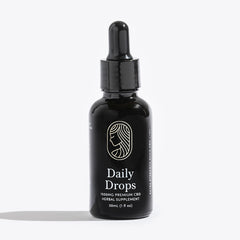
If your existing routine — whether that's Daily Drops, Daily Softgels, or Daily Gummies — is working well for stress and daytime balance but you want additional nighttime support, CBN can be added as a focused layer.
Rapid Sleep Melts* are designed for exactly this. Each melt delivers 5mg CBN, 10mg GABA, and 12mg Tart Cherry Extract — sublingual delivery means absorption starts quickly, making them well-suited for the moments right before bed or even mid-night if you're struggling to fall back asleep. There's no CBD in the formula, so Rapid Sleep Melts layer cleanly on top of whatever CBD product you're already using without changing your baseline.
GABA and Tart Cherry Extract bring additional support to the formula: GABA for nervous system calming, and Tart Cherry as a natural source of melatonin precursors. Together, these address the sleep-onset window from multiple directions.
CBN as Part of a Complete Nighttime Formula
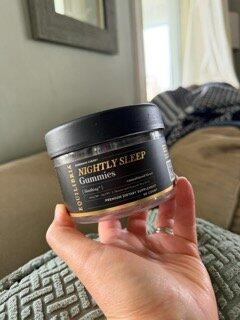
For those who want an all-in-one nighttime formula, Nightly Sleep Gummies* combine the CBD + CBN pairing with L-Theanine and Chamomile in a single serving — making it a complete nighttime protocol without requiring additional products.
Each serving (two gummies) delivers 25mg CBD, 5mg CBN, 25mg L-Theanine, and 25mg Chamomile. The CBD and CBN work on the ECS from their respective angles; L-Theanine supports alpha-wave activity and calming without sedation; Chamomile contributes mild GABAergic modulation.
You can also use a single gummy (12.5mg CBD, 2.5mg CBN) as a lighter option or as a half-serving that stacks well with other products — more on that below.
Building a Cannabinoid Stack with THC
For members who also use Equilibria's low-dose THC options, CBN opens up some interesting stacking combinations. One popular example:
1 Nightly Sleep Gummy (12.5mg CBD, 2.5mg CBN) + 1 Ellevate Gummy (2.5mg THC, 5mg CBD)*
This brings together all three primary cannabinoids — CBD, CBN, and a micro-dose of THC — each contributing at a different receptor point. The result is a rounded cannabinoid profile: CBD supporting ECS tone broadly, CBN adding partial CB1 engagement, and micro-THC completing the CB1 picture at a dose calibrated for balance rather than intoxication.
Total in this combination: 17.5mg CBD, 2.5mg CBN, 2.5mg THC. It's an example of how Equilibria's different product building blocks can be combined to fine-tune a routine that fits your individual needs — not a one-size-fits-all prescription. For personalized guidance, our Certified Wellness Coaches offer 1:1 support for exactly this kind of routine design.
Frequently Asked Questions
What is CBN? CBN, or cannabinol, is a minor cannabinoid that forms naturally as THC oxidizes over time in hemp and cannabis. At the low doses used in hemp-derived products, it is non-intoxicating. CBN interacts with the endocannabinoid system as a partial agonist at CB1 receptors — a different mechanism than CBD, which modulates ECS tone without directly binding to CB1.
Is CBN the same as CBD? No. Both are cannabinoids found in hemp, but they have different structures, different mechanisms of action, and different roles in a cannabinoid routine. CBD modulates the ECS broadly through indirect pathways. CBN engages CB1 receptors more directly at partial potency. They address different aspects of the sleep equation and work best used together, not interchangeably.
Does CBN make you high? CBN is non-intoxicating at the doses used in hemp-derived products. While it shares a receptor pathway with THC, its potency at CB1 receptors is significantly lower, and the low doses in hemp formulas — typically 2.5–5mg — are far below the threshold for intoxicating effects.
What is the best way to take CBN for sleep? It depends on what your routine already looks like. If you have a CBD baseline and want to add a targeted sleep layer, Rapid Sleep Melts (5mg CBN + GABA + Tart Cherry) work well as an add-on. If you prefer a complete nighttime formula, Nightly Sleep Gummies combine CBD and CBN with L-Theanine and Chamomile in a single product. And if you use low-dose THC products, pairing one Nightly Sleep Gummy with an Ellevate Gummy creates a rounded cannabinoid profile across multiple receptor pathways.
Can I take CBN with my daily CBD products? Yes. CBN stacks cleanly with CBD — they work on different parts of the ECS and are designed to complement each other. Rapid Sleep Melts contain no CBD, so they layer directly on top of any Daily CBD product without changing your daytime baseline. For personalized guidance, our Wellness Coaches can help you find the right combination for your specific routine and goals.