
Here's a truth that most of us don't sit with: chronic stress and sleep disruption are not single-pathway problems. They are systemic dysregulation events that involve the endocannabinoid system, the HPA axis, GABAergic signaling, serotonergic pathways, and mineral metabolism — simultaneously, interdependently, and over time.
A single ingredient addressing a single pathway may produce meaningful results in acute situations or in people with mild imbalance. For women dealing with months or years of accumulated stress, layered support that addresses multiple systems at once is typically where the real, lasting shift happens.
This is the science behind why CBD works better alongside Ashwagandha, Magnesium, and 5-HTP — not instead of them.
Key Takeaways:
- Chronic stress is a multi-pathway problem. The ECS, HPA axis, GABAergic system, and serotonergic pathway are all implicated — no single ingredient reaches all of them.
- Full-spectrum CBD works through the endocannabinoid system [1] — a body-wide regulatory network modulating stress, mood, sleep, and inflammation. The entourage effect of whole-plant CBD produces systemic effects isolated CBD cannot replicate [2].
- CBD + Ashwagandha addresses two different levels of the stress response: CBD manages real-time reactivity through the ECS; Ashwagandha recalibrates the HPA axis cortisol set point over 8–12 weeks [3].
- CBD + Magnesium pairs ECS-driven GABAergic modulation with the direct mineral substrate GABA receptors require to function — two different mechanisms, converging on the same outcome.
- Layering is about biological coverage, not redundancy. Each ingredient addresses a distinct system that chronic stress disrupts. Together, they map to the full picture.
What Does CBD Actually Do in the Body?
CBD (cannabidiol) is a phytocannabinoid derived from the hemp plant. It interacts primarily with the endocannabinoid system (ECS) — a regulatory network present throughout the brain and body that governs stress response, mood, sleep, inflammation, immune function, and pain perception [1].
The ECS operates through two primary receptor types: CB1 receptors (concentrated in the brain and central nervous system) and CB2 receptors (concentrated in immune tissue and peripheral organs). CBD's relationship with these receptors is indirect — it doesn't bind strongly to either, but modulates their activity and influences the metabolism of the body's own endocannabinoids (anandamide and 2-AG).
CBD also interacts with serotonin 5-HT1A receptors [4] — a receptor subtype associated with anxiety reduction and mood regulation — and with other receptor systems implicated in pain, inflammation, and neurological function.
What this means in practice: CBD doesn't do one thing. It influences a regulatory system that touches virtually every other biological pathway relevant to stress, mood, and sleep. That's its strength — and it's why combining it with targeted co-factors can produce additive effects.
Full-spectrum CBD — which retains the full range of naturally occurring cannabinoids, terpenes, and plant compounds — is supported by the entourage effect hypothesis [2]: the idea that these compounds work synergistically, producing effects that isolated CBD cannot replicate. Equilibria uses exclusively full-spectrum hemp formulations for this reason.
How Do CBD and Ashwagandha Work Together?
CBD and Ashwagandha operate at different levels of the stress response system — which is precisely why they complement each other.
CBD works at the level of real-time stress response. It modulates the ECS to help the body maintain equilibrium when stress signals arrive — reducing the intensity of the acute response through CB1 receptor influence on the amygdala and prefrontal cortex, and through 5-HT1A activity that dampens anxiety signaling.
Ashwagandha works upstream, at the HPA axis itself — progressively recalibrating how sensitively the stress command center responds to triggers over time. Clinical research demonstrates significant reductions in cortisol after 8–12 weeks of consistent use [3]. It doesn't blunt the stress response — it raises the threshold at which the system activates and improves how efficiently it returns to baseline afterward.
Put simply:
- CBD: "The body is experiencing a stress signal right now — let's modulate the response."
- Ashwagandha: "The body's stress-response set point is too sensitive — let's recalibrate it over weeks."
These don't compete. CBD manages daily reactivity while Ashwagandha builds the long-term resilience that makes CBD's job easier over time. Equilibria's Daily Stress Gummies deliver 500mg Ashwagandha per serving alongside L-Theanine, Lemon Balm, and Passionflower* — pair with CBD Daily Drops or CBD Daily Gummies for full-day coverage across both pathways.*
If you have a thyroid condition, consult your healthcare provider before adding Ashwagandha. Questions? Reach us at wellness@myeq.com.
How Do CBD and Magnesium Work Together?
CBD's influence on GABA is indirect — it works through the ECS's modulation of GABAergic neuron activity across multiple brain regions. Magnesium's influence on GABA is direct and structural — it's the mineral co-factor that GABA receptors require to function at all.
Think of it this way: CBD helps optimize how the GABAergic system is being regulated; magnesium provides the raw mineral substrate the system needs to actually work. Without adequate magnesium, GABA receptors are underresponsive regardless of how well the ECS is functioning.
For sleep specifically, the pairing is particularly well-matched:
- CBD (especially with CBN) supports the neurological transition from wakefulness to sleep by modulating ECS activity in sleep-regulating regions of the brainstem*
- Magnesium glycinate supports GABA receptor function, blocks excitatory NMDA receptor signaling, supports melatonin synthesis, and facilitates core body temperature reduction — all biochemical prerequisites for deep, sustained sleep*
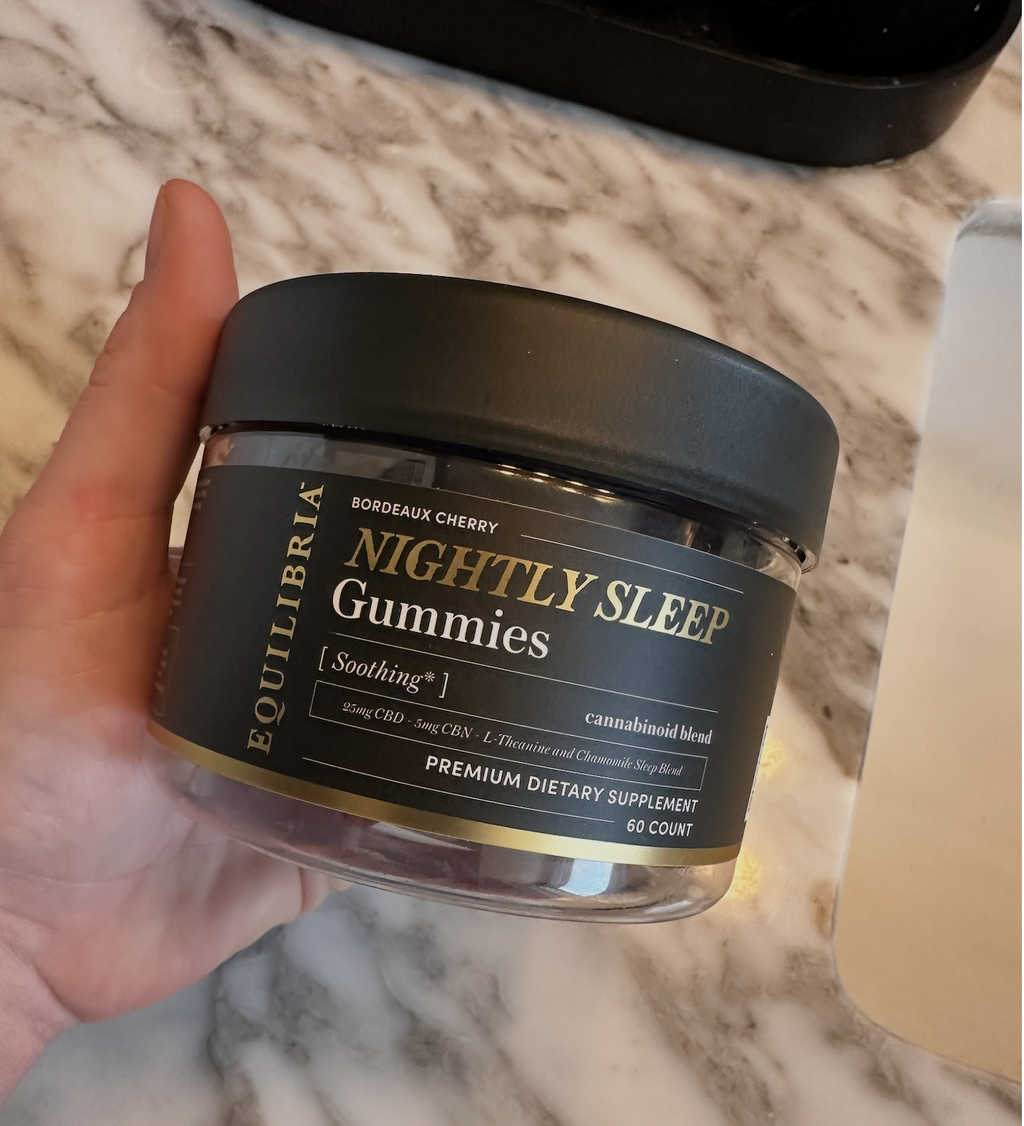
These mechanisms don't overlap — they address different prerequisites for the same outcome. Equilibria's CBD Nightly Sleep Gummies (25mg CBD + 5mg CBN + 25mg L-Theanine) paired with Deep Sleep Magnesium (275mg magnesium glycinate) represent this layer in practice.*
How Do CBD and 5-HTP Work Together?
5-HTP (5-hydroxytryptophan) is the direct precursor to serotonin in the brain [5]. Unlike tryptophan, which must compete with other amino acids for transport across the blood-brain barrier, 5-HTP crosses efficiently and converts to serotonin directly. Serotonin then converts to melatonin — a conversion that also requires magnesium and B6 as co-factors.
The relevance to CBD: CBD interacts with serotonin 5-HT1A receptors [4] — a specific receptor subtype associated with anxiety reduction and mood stabilization. This is a receptor-level interaction; CBD can only modulate this receptor effectively if there's adequate serotonin available in the system.
5-HTP ensures that serotonin precursor availability is not the bottleneck. CBD then helps that serotonin signal translate more effectively through receptor-level modulation. The two work on different ends of the serotonergic pathway — supply (5-HTP) and receptor sensitivity (CBD).
For women experiencing stress-related mood disruption, low motivation, or anxiety with a strong emotional or cognitive component, this serotonin-ECS combination is particularly relevant.
If you are currently taking an SSRI, SNRI, or any other serotonin-active medication, consult your prescribing physician before adding 5-HTP. Concurrent use may affect serotonin levels and is not appropriate for everyone. This is a clinical safety consideration, not medical advice.
Why Does Layering Outperform Single-Ingredient Approaches?
Each pairing in this stack addresses a genuinely distinct biological system:
| Layer | Mechanism | Timeline |
|---|---|---|
| CBD | ECS regulatory modulation — systemic | Real-time, ongoing |
| Ashwagandha | HPA axis recalibration — cortisol set point | Cumulative, 8–12 weeks |
| Magnesium glycinate | GABA infrastructure, NMDA blockade, melatonin synthesis | Nightly mineral substrate |
| 5-HTP | Serotonin precursor supply | Daily, typically evening |
None of these pathways is redundant with the others. Chronic stress and sleep disruption engage all of them — which is why single-ingredient approaches consistently produce partial results. Strategic layering isn't about taking more supplements. It's about addressing the full biological picture of what chronic stress actually does to the body.
Equilibria's Reset Lab collection — including the Daily Stress Gummies, Deep Sleep Magnesium, and the full CBD lineup — is built around exactly this philosophy: not one solution for one symptom, but a coordinated system for sustainable balance.*
Building the right personalized stack depends on your specific stress pattern, timeline, and health history. Equilibria's 1:1 Wellness Coaches can help you sequence and layer these ingredients for your individual biology and goals.
Frequently Asked Questions
Can you take CBD and Ashwagandha together? Yes — CBD and Ashwagandha work through complementary mechanisms and there is no known interaction between them. CBD modulates the endocannabinoid system in real time; Ashwagandha recalibrates the HPA axis cortisol set point cumulatively over 8–12 weeks. Together, they address two different levels of the stress response system. If you have a thyroid condition, consult your healthcare provider before starting Ashwagandha specifically.
Can you take CBD and magnesium together for sleep? CBD and magnesium glycinate are a well-matched pairing for sleep. They work through different mechanisms — CBD modulates ECS-driven GABAergic regulation in the brainstem; magnesium provides the direct mineral substrate GABA receptors need to function, and blocks excitatory NMDA signaling. There is no known interaction, and their mechanisms are complementary rather than overlapping.
What is 5-HTP and how does it work with CBD? 5-HTP is the direct precursor to serotonin in the brain. It crosses the blood-brain barrier efficiently and converts to serotonin directly. CBD interacts with serotonin 5-HT1A receptors, which modulate anxiety and mood — but those receptors need adequate serotonin available to work effectively. 5-HTP supports serotonin supply; CBD supports receptor sensitivity. Together they address the serotonergic pathway from both ends. Note: do not take 5-HTP alongside SSRIs or other serotonin-active medications without consulting your prescribing physician.
What is the entourage effect in full-spectrum CBD? The entourage effect refers to the synergistic activity of the full range of cannabinoids, terpenes, and plant compounds present in full-spectrum hemp extract. The hypothesis — supported by emerging research — is that these compounds interact with each other and with the ECS in ways that isolated CBD cannot replicate. This is why Equilibria uses full-spectrum formulations rather than CBD isolate.
How long does it take for a CBD supplement stack to work? It depends on the ingredient. CBD's effects on the ECS can be felt within hours to days with consistent use. L-Theanine promotes alpha brain wave activity within 30–40 minutes. Ashwagandha's HPA axis recalibration is cumulative, with meaningful cortisol reduction typically observed after 8–12 weeks. Magnesium repletion takes 2–4 weeks of daily use to restore tissue stores. A complete stack works across multiple timescales simultaneously — some effects are immediate, some build over weeks.